file-20260107-62-pag525.jpg

A Man on the Inside: Netflix comedy offers a timely defence of higher education

Season 2 of Netflix’s A Man on the Inside finds Charles Nieuwendyk, private investigator and retired engineering professor (played by Ted Danson), undercover at Wheeler College.

The mission: recover the college president’s laptop. This might not seem juicy, but said laptop contains sensitive information about a $400 million donation by a tech multibillionaire, Brad Vinick.

As someone who has lived and studied academic life, I find the series created by Michael Schur (also behind The Good Place starring Ted Danson, among other hit series) is both funny and uncomfortable because it hits close to home.

Budgets trimmed to the bone

The P.I. is thrilled by his university case, calling it something “I can really sink my teeth into.”

Wheeler College, founded in 1883, has seen better days. It is struggling financially and its leadership is unpopular. The board of trustees hired a president who trims department budgets to the bone, cuts student aid and embraces corporate sponsorship — as well as the bonus he receives with every major donation.

These measures are not enough. Enter Vinick.

‘A Man on the Inside’ Season 2 trailer.

Vinick’s secret plan — “Project Aurora” — is to fire half the professors, exclude faculty from decision-making and close what he considers “non-essential departments,” leaving “three tracks of study — biotechnology, economics and computer science to prepare young adults for life in the modern world.”

President Jack Beringer knows Vinick’s intentions but does not want anyone to know he knows. Faculty uprisings would not help his bid for a higher-paying university job in Dallas, where he ate the best steak ever.

Language of efficiency, innovation

Any campus stroll reveals that Wheeler’s “Pepsi T-Mobile Covered Garage brought to you by Sephora” (Episode 4) is only a slight exaggeration.

Vinick’s language of efficiency and innovation dominates in real life. Universities are run increasingly on a corporate model, as numerous studies have demonstrated, including my collaboration with Maggie Berg in our book The Slow Professor: Challenging the Culture of Speed in the Academy.

Budgets and programs are being slashed, and in the guise of economic necessity, principles of higher education are undermined.

Professors also satirized

While Beringer and Vinick are the villains of the piece, there are, of course, some digs at the professors. (I admit we are an easy target).

The musicologist, for example, will abandon any conversation mid-sentence when inspiration hits.

In Episode 4, we see the chair of the English department is a snob about books you can buy at airports.

However, the show resists indulging in nutty, overpaid professor stereotypes because it recognizes, in the words of Dr. Benjamin Cole, head of the English department, “these are not the best of times.” The show focuses on staff and faculty efforts in an era of budget cuts and attacks on what the billionaire investor calls “pointless subjects” like art history and philosophy.

Holly Bodgemark, the provost, is so overworked she swallows nicotine gum (“It works faster if it goes right to the stomach”) and mixes her own “Peptocoffee.”

The musicologist may be flaky, but she buys used instruments out of her own pocket for students who can’t afford them. Money is tight for students. Student Claire Chung works a dozen jobs to pay tuition and housing. “When do you sleep?” Nieuwendyk asks. “In class,” she replies.

Defending higher education

To defend higher education, the show calls in the big guns: Ozymandias, a sonnet by 19th- century Romantic writer Percy Bysshe Shelley. It’s mentioned in one of Cole’s lectures, where he recites some of its lines and comments on its continued relevance: “Money, fame, power do not last. But ideas … can endure.”
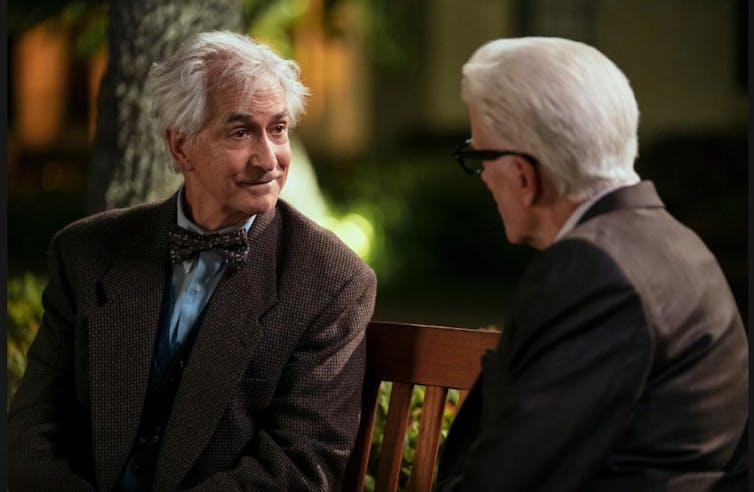
Two men in discussion on a bench.
Literature professor Dr. Cole tells his students: ‘ideas … can endure.’
(Netflix)

Published in 1818, Ozymandias speaks of a “traveller from an antique land.” The traveller comes across the remains of a sculpture with an inscription that reads:

“‘My name is Ozymandias, King of Kings,

Look on my Works ye Mighty, and despair!’”

The rest of the sculpture is a “colossal Wreck,” and the king’s boast has dwindled into unintentional irony.

Given that the show is American, the literary allusion might be a veiled reference to the No Kings protests.

Making sense of the present

The series seems to side with philosophers like Martha Nussbaum, who argues that a liberal arts education can help us make sense of the present and read it critically.

Vinick is a modern Ozymandias. He wants to be immortal, literally (he undergoes longevity treatments) and figuratively (he commissions oil portraits of himself). As the professor of fine arts notes in the first episode of Season 2: “Newsflash: the billionaire is a narcissist.”

Not to give away the mystery, but a crisis is averted. Wheeler is safe … for now. It might go under, but, as the provost says, “better to end on our own terms.”

And those terms are: education is not a business; it cannot be reduced to the delivery of quantifiable outcomes. The book What Are Universities For?, by Stefan Collini, professor emeritus of intellectual history and English literature, makes this case in a particularly compelling (and at times laugh-out-loud) way.

Higher education is a public good because it teaches critical thinking and civil debate and prepares engaged citizens.

Community

Good satire like A Man on the Inside points out the problems as well as possible remedies. Vinick mocks the notion of community, but the show values it above all because, without it, resistance is impossible. Wheeler College’s faculty and staff celebrate each other and band together across disciplinary divides.

In the words of the provost in the last episode of the season, they are committed to protecting “community and knowledge for the sake of knowledge.”

Schur’s comedy offers a timely defence of higher education and is notable for bridging the gap between academics and the general public.

The Conversation

Barbara K Seeber received a Social Sciences and Humanities Research Council Institutional Grant at Brock University.

file-20260108-56-3lcwjl.jpg

Financial case for college remains strong, but universities need to add creative thinking to their curriculum

Unemployment rates are lower among people who have a college degree, compared to those with a high school degree. Wong Yu Liang/iStock Images/Getty Images

A college degree was once seen as the golden ticket to landing a well-paying job. But many people are increasingly questioning the value of a four-year degree amid the rising cost of college.

Almost two-thirds of registered voters said in an October 2025 NBC News poll that a four-year college degree isn’t worth the cost – marking an increase from 40% of registered voters who said that college wasn’t worth the cost in June 2013.

Caroline Field Levander, the vice president for global strategy and an English professor at Rice University, argues in her December 2025 book “Invent Ed” that people have lost sight of two factors that made universities great to begin with: invention and creativity.

Amy Lieberman, education editor at The Conversation U.S., spoke with Levander to break down the benefits of going to college and university – and how schools can better demonstrate their enduring value.

How can we measure the value of a college degree?

College graduates earn substantially more than people who do not have a college degree.

The average high school graduate over a 40-year career earns US$1.6 million, according to 2021 findings by the Georgetown University Center on Education and Workforce. The average college graduate, over this same 40-year time frame, earns $2.8 million. That $1.2 million difference amounts to around $30,000 more salary per year.

People who earn a degree more advanced than a bachelor’s, on average, earn $4 million over 30 years, making the lifetime earning difference $2.4 million between these graduates and people with just a high school diploma.

College graduates are also better protected against job loss, and they weather job disruption cycles better than high school graduates.

The unemployment rate for people with a high school degree was 4.2% in 2024, according to the U.S. Bureau of Labor Statistics. By contrast, 2.5% of people with a bachelor’s degree and 2.2% of people with a master’s degree were unemployed in 2024.

Do any of these benefits extend beyond individual students?

In addition to the substantial financial benefits college graduates experience, colleges and universities are major employers in their communities – and not just professors and administrators. Higher education institutions employ every trade and kind of worker, from construction workers to police, to name a few.

Universities are crucial to developing and strengthening the U.S. economy in other ways. The discoveries that faculty and researchers make in laboratories lead to new products, businesses and ideas that drive the U.S. economy and support the country’s financial health.

Researchers at the University of Texas Southwestern did important work in helping to discover statins, while scientists at the University of Pennsylvania developed the mRNA vaccine. The list of inventions that started at universities goes on and on.

Some people are questioning the value of a degree. What role can universities play in reassuring them of their relevance?

Discovery and invention have traditionally been the focus of many graduate programs and faculty research, while undergraduate college educations tend to focus on ensuring that students are able to successfully enter the workforce after graduation.

Undergraduate students need to gain competency in a field in order to contribute to society and advance knowledge.

But I believe universities need to teach something else that is equally valuable: They also need to build creative capacity and an inventive mindset into undergraduate education, as a fundamental return on the investment in education.

Employers report that creativity is the top job skill needed today. The IBM Institute for Business Value, for example, concluded in 2023 that creativity is the must-have skill for employee success in the era of generative AI.

The Harvard Business Review reports that employers are developing short courses aimed to build creative capability in their workers.

A woman with dark hair looks down with various small images around her.
Creativity and innovation are both likely to become increasingly important for young people entering the workplace, especially as AI continues to grow.
Andriy Onufriyenko/iStock/Getty Images

What can faculty and students easily do to encourage creativity and innovation?

Professors can build what I call a “growth mindset” in the classroom by focusing on success over time, rather than the quick correct answer. Faculty members can ask themselves as they go into every class, “Am I encouraging a growth mindset or a fixed mindset in these students?” And they can use that answer to guide how they are teaching.

Students could also consider committing to trying new courses in areas where they haven’t already been successful. They could approach their college experience with the idea that grades aren’t the only marker of success. And I think they could benefit from developing thoughtful ways to describe their journey to future employers. Simple practices like keeping a creativity notebook where they record the newest ideas they have, among many others that I describe in my new book, will help.

And university leaders need to open the aperture of how we define our own success and our university’s success so that it includes creative capability building as part of the undergraduate curriculum.

The Conversation

Caroline Levander does not work for, consult, own shares in or receive funding from any company or organization that would benefit from this article, and has disclosed no relevant affiliations beyond their academic appointment.