file-20251014-56-wis48a.jpg

How this year’s Nobel winners changed the thinking on economic growth

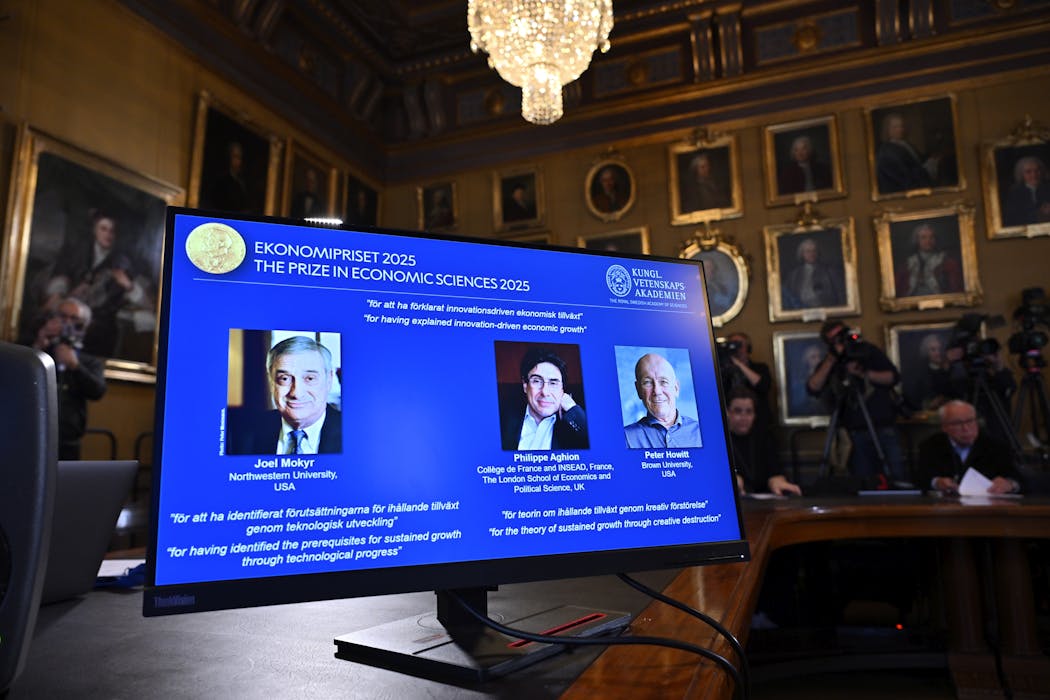
The prizewinners were announced at a ceremony in Stockholm. EPA/ANDERS WIKLUND SWEDEN OUT

What makes some countries rich and others poor? Is there any action a country can take to improve living standards for its citizens? Economists have wondered about this for centuries. If the answer to the second question is yes, then the impact on people’s lives could be staggering.

This year’s Sveriges Riksbank Prize in Economic Sciences (commonly known as the Nobel prize for economics) has gone to three researchers who have provided answers to these questions: Philippe Aghion, Peter Howitt and Joel Mokyr.

For most of human history, economic stagnation has been the norm – modern economic growth is very recent from a historical point of view. This year’s winners have been honoured for their contributions towards explaining how to achieve sustained economic growth.

At the beginning of the 1980s, theories around economic growth were largely dominated by the works of American economist Robert Solow. An important conclusion emerged: in the long-run, per-capita income growth is determined by technological progress.

Solow’s framework, however, did not explain how technology accumulates over time, nor the role of institutions and policies in boosting it. As such, the theory can neither explain why countries grow differently for sustained periods nor what kind of policies could help a country improve its long-run growth performance.

It’s possible to argue that technological innovation comes from the work of scientists, who are motivated less by money than the rest of society might be. As such, there would be little that countries could do to intervene – technological innovations would be the result of the scientists’ own interests and motivations.

But that thinking changed with the emergence of endogenous growth theory, which aims to explain which forces drive innovation. This includes the works of Paul Romer, Nobel prizewinner in 2018, as well as this year’s winners Aghion and Howitt.

These three authors advocate for theories in which technological progress ultimately derives from firms trying to create new products (Romer) or improve the quality of existing products (Aghion and Howitt). For firms to try to break new ground, they need to have the right incentives.

Creative destruction

While Romer recognises the importance of intellectual property rights to reward firms financially for creating new products, the framework of Aghion and Howitt outlines the importance of something known as “creative destruction”.

This is where innovation results from a battle between firms trying to get the best-quality products to meet consumer needs. In their framework, a new innovation means the displacement of an existing one.

In their basic model, protecting intellectual property is important in order to reward firms for innovating. But at the same time, innovations do not come from leaders but from new entrants to the industry. Incumbents do not have the same incentive to innovate because it will not improve their position in the sector. Consequently, too much protection generates barriers to entry and may slow growth.

But what is less explored in their work is the idea that each innovation brings winners (consumers and innovative firms) and losers (firms and workers under the old, displaced technology). These tensions could shape a country’s destiny in terms of growth – as other works have pointed out, the owners of the old technology may try to block innovation.

This is where Mokyr complements these works perfectly by providing a historical context. Mokyr’s work focuses on the origins of the Industrial Revolution and also the history of technological progress from ancient times until today.

Mokyr noted that while scientific discoveries were behind technological progress, a scientific discovery was not a guarantee of technological advances.

It was only when the modern world started to apply the knowledge discovered by scientists to problems that would improve people’s lives that humans saw sustained growth. In Mokyr’s book The Gifts of Athena, he argues that the Enlightenment was behind the change in scientists’ motivations.
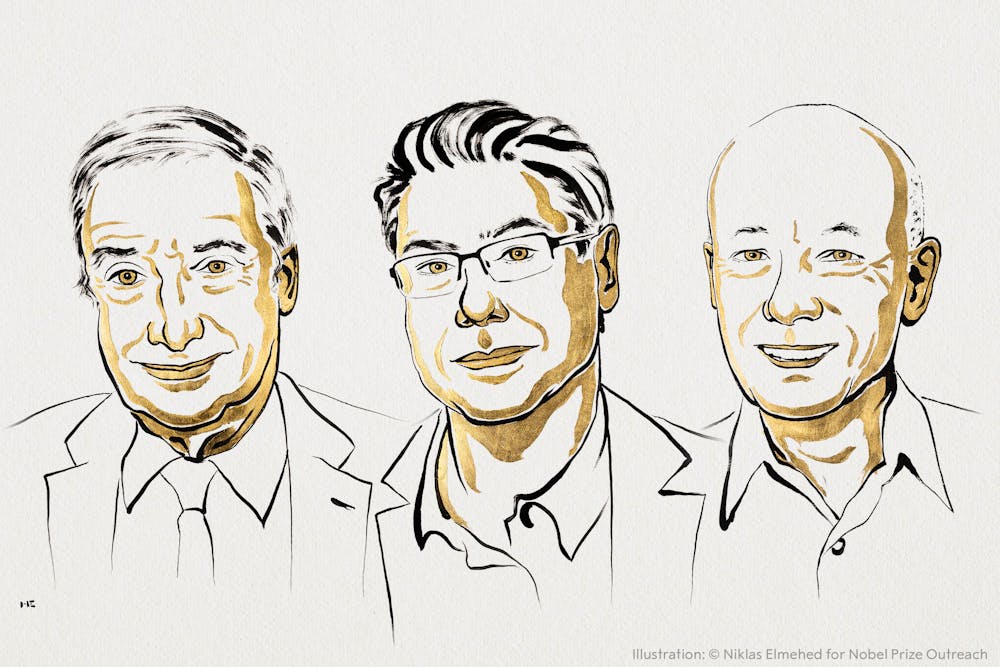
illustrated headshots of the 2025 nobel prizewinners in economics.
The 2025 winners Joel Mokyr, Philippe Aghion and Peter Howitt.
Ill. Niklas Elmehed © Nobel Prize Outreach

In Mokyr’s works, for growth to be sustained it is vital that knowledge flows and accumulates. This was the spirit embedded in the Industrial Revolution and it’s what fostered the creation of the institution I am working in – the University of Sheffield, which enjoyed financial support from the steel industry in the 19th century.

Mokyr’s later works emphasise the key role of a culture of knowledge in order for growth to improve living standards. As such, openness to new ideas becomes crucial.

Similarly, Aghion and Howitt’s framework has become a standard tool in economics. It has been used to explore many important questions for human wellbeing: the relationship between competition and innovation, unemployment and growth, growth and income inequality, and globalisation, among many other topics.

Analysis using their framework still has an impact on our lives today. It is present in policy debates around big data, artificial intelligence and green innovation. And Mokyr’s analysis of how knowledge accumulates poses a central question around what countries can do to encourage an innovation ecosystem and improve the lives of their citizens.

But this year’s prize is also a warning about the consequences of damaging the engines of growth. Scientists collaborating with firms to advance living standards is the ultimate elixir for growth. Undermining science, globalisation and competition might not be the right recipe.

The Conversation

Antonio Navas does not work for, consult, own shares in or receive funding from any company or organisation that would benefit from this article, and has disclosed no relevant affiliations beyond their academic appointment.
file-20251013-66-6u10vb.jpg

The 2025 Nobel economics prize honours economic creation and destruction

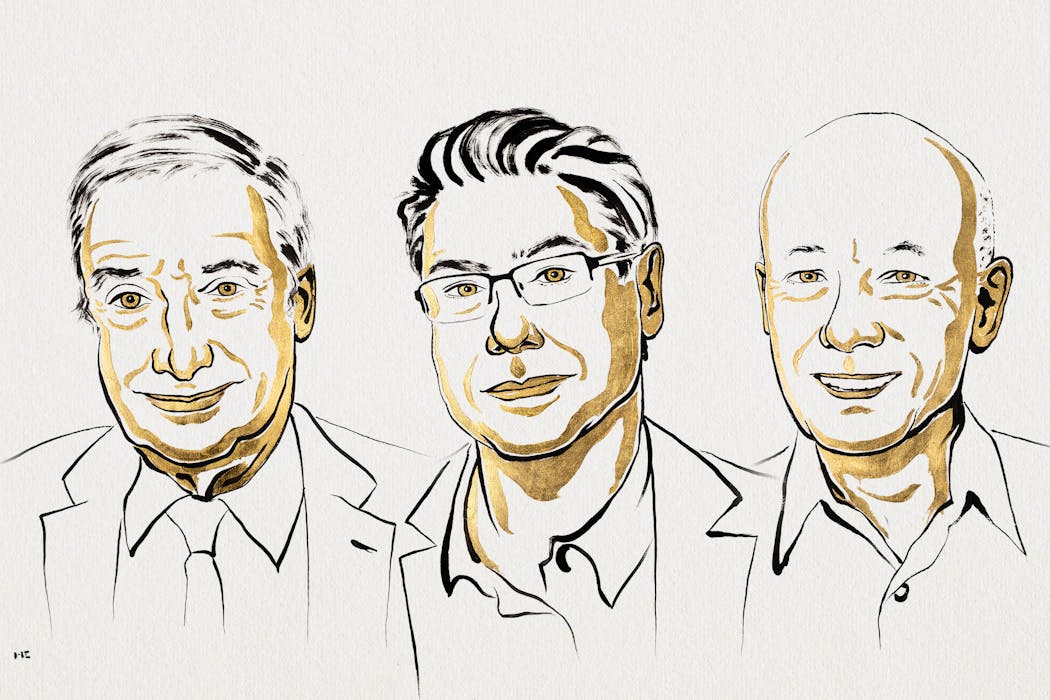
Economists Joel Mokyr, Philippe Aghion, and Peter Howitt. Ill. Niklas Elmehed © Nobel Prize Outreach

Three economists working in the area of “innovation-driven economic growth” have won this year’s Nobel Memorial Prize in Economic Sciences.

Half of the 11 million Swedish kronor (about A$1.8 million) prize was awarded to Joel Mokyr, a Dutch-born economic historian at Northwestern University.

The other half was jointly awarded to Philippe Aghion, a French economist at Collège de France and INSEAD, and Peter Howitt, a Canadian economist at Brown University.

Collectively, the trio’s work has examined the importance of innovation in driving sustainable economic growth. It has also highlighted that in dynamic economies, old firms die as new firms are being born.

Innovation drives sustainable growth

As noted by the Royal Swedish Academy of Sciences, economic growth has lifted billions of people out of poverty over the past two centuries. While we take this as normal, it is actually very unusual in the broad sweep of history.

The period since around 1800 is the first in human history when there has been sustained economic growth. This warns us we should not be complacent. Poor policy could see economies stagnate again.

One of the Nobel judges gave the example that in Sweden and the United Kingdom there was little improvement in living standards in the four centuries between 1300 and 1700.

Mokyr’s work showed that prior to the Industrial Revolution, innovations were more a matter of trial and error than being based on scientific understanding. He has argued that sustained economic growth would not emerge in:

a world of engineering without mechanics, iron-making without metallurgy, farming without soil science, mining without geology, water-power without hydraulics, dyemaking without organic chemistry, and medical practice without microbiology and immunology.

Mokyr gives the example of sterilising surgical instruments. This had been advocated in the 1840s or earlier. But surgeons were offended by the suggestion they might be transmitting diseases. It was only after the work of Louis Pasteur and Joseph Lister in the 1860s that the role of germs was understood and sterilisation became common.

Mokyr emphasised the importance of society being open to new ideas. As the Nobel committee put it:

practitioners, ready to engage with science, along with a societal climate embracing change, were, according to Mokyr, key reasons why the Industrial Revolution started in Britain.

Winners and losers

This year’s other two laureates, Aghion and Howitt, recognised that innovations create both winning and losing firms. In the US, about 10% of firms enter and 10% leave the market each year. Promoting economic growth requires an understanding of both processes.

Their 1992 article built on earlier work on the concept of “endogenous growth” – the idea that economic growth is
generated by factors inside an economic system, not the result of forces that impinge from outside. This earned a Nobel prize for Paul Romer in 2018.

It also drew on earlier work on “creative destruction” by Joseph Schumpeter.

The model created by Aghion and Howitt implies governments need to be careful how they design subsidies to encourage innovation.

If companies think that any innovation they invest in is just going to be overtaken (meaning they would lose their advantage), they won’t invest as much in innovation.

Their work also supports the idea governments have a role in supporting and retraining those workers who lose their jobs in firms that are displaced by more innovative competitors.

This will build political support for policies that encourage economic growth, as well.

‘Dark clouds’ on the horizon?

The three laureates all favour economic growth, in contrast to growing concerns about the impact of endless growth on the planet.

In an interview after the announcement, however, Aghion called for carbon pricing to make economic growth consistent with reducing greenhouse gas emissions.

He also warned about the gathering “dark clouds” of tariffs; that creating barriers to trade could reduce economic growth.

And he said we need to ensure today’s innovators do not stifle future innovators through anti-competitive practices.

The newest Nobel prize

The economics prize was not one of the five originally nominated in Swedish chemist Alfred Nobel’s will in 1895. It is formally called the Sveriges Riksbank Prize in Economic Sciences in Memory of Alfred Nobel. It was first awarded in 1969.

The awards to Mokyr and Howitt continue the pattern of the economics prize being dominated by researchers working at US universities.

It also continues the pattern of over-representation of men. Only three of the 99 economics laureates have been women.

Arguably, economics professor Rachel Griffith, rather than Mokyr, could have shared the prize with Aghion and Howitt this year. She co-authored the book Competition and Growth with Aghion, and co-wrote an article on competition with both of them.

The Conversation

John Hawkins does not work for, consult, own shares in or receive funding from any company or organisation that would benefit from this article, and has disclosed no relevant affiliations beyond their academic appointment.

file-20251005-56-hl24k8.jpg

Young businesses create 6 in 10 new jobs in Australia – far more than established firms

Chris Putnam/Future Publishing via Getty Images

Governments of all stripes provide support to small businesses in the form of tax concessions, lighter-touch regulation or government grants. They’re called the “engine room” of the economy. But is small really best?

In recent research, my co-authors and I explored this question by looking at the contributions that firms of different ages and size make to the economy.

We found new and young businesses, rather than small, old businesses, are the drivers of economic growth. This matters, as the economic dynamism these young firms drive boosts productivity – the major determinant of incomes in the long run. But government policy is focused on size, which may be holding us back.

Using de-identified data from the Australian Bureau of Statistics that tracks all businesses in Australia, we analysed the economic performance of each individual business in the market sector from 2003 onward – from pubs and cafes to manufacturing.

This includes all business types and sizes, from the corner store to the major corporates. We analysed how many people they employed, their economic value-add (think of it as their contribution to the economy), and their labour productivity (how much stuff they produce for a given amount of workers and hours).

Australia has some 2.7 million small businesses, with 440,000 new businesses started in 2024-25. But our study finds it’s young firms (those aged five years or less) that punch above their weight and have an outsized positive contribution to the economy, while small, old firms (aged over five, and with fewer than 15 employees) have a net negative impact.

Engines of job creation

Our research found young businesses contribute six percentage points to overall annual headcount growth. This compares to small, old firms, which actually reduce overall annual headcount growth by 4.5 percentage points, due to these firms stagnating, shrinking and closing down.

This difference is underlined when we look separately at job creation and job destruction. Young firms contribute 59% of new jobs, while small old firms account for just 16%.

This is even more stark when comparing job losses: small old businesses account for 41% of all job destruction. Large old businesses – often the focus of announced corporate layoffs – account for 18% of job destruction.

So is young best then? As economists like to say – it depends.

We analysed the growth trajectories of young firms and found significant differences.

Of firms that survive to age five, high-performing young firms employ twice the number of workers than the average firm of the same age, and are over 40% more productive.

But the typical new business (in its first year of activity) is relatively small, employing only around two people. And it stops growing relatively quickly – on average new firms plateau after two years of operation. This highlights the vast differences in firm types among young firms.

This might not be surprising to some readers; not all new businesses are started with the goal of being the next Atlassian or Canva.

People start businesses for a range of reasons: whether you’re a lawyer who’d rather be your own boss than work for a large corporation; an IT worker who recently had a child and values control over the flexibility of your time; or a tradie who benefits from the tax implications of running your own business.

Smarter ways to support all businesses

This highlights the importance of policymakers being clear on what they’re trying to achieve when providing subsidies and support to businesses.

Our analysis suggests if the policy goal is to spur economic growth and employment, then targeting assistance to small businesses is poor policy. But this doesn’t necessarily mean we should take that assistance and give it to young firms instead.

Since a small number of high-performing young firms drive economic growth, we won’t always know which young firms these will be. Policy that subsidises young firms would potentially still be ineffective. And we know government has a chequered history with picking winners – see the more than A$30 billion provided to the car manufacturing sector.

So, what should government do?

One often overlooked and potentially counterintuitive finding from our research is the role of firm “exits” – businesses closing down or moving onto new ventures. Firms that exit are 20% less productive than the average firm in their industry five years before they close down, and their productivity declines further as they approach closure.

But the rate of business closures in Australia has been declining over time. Policies that remove impediments from orderly business closure, including supporting affected workers, would help workers and capital to be re-allocated to more productive and innovative firms.

Specific business assistance and targeting is always fraught with difficulty. Policymakers can instead focus on broader policy settings that are conducive to growth, and that apply to all firms rather than just a subset.

These efforts, such as streamlining regulation and ensuring it is fit for purpose for all businesses, would be in line with some of the principles and reform directions agreed at Treasurer Jim Chalmers’ economic reform roundtable earlier this year.

The author thanks Rachel Lee and Ewan Rankin, researchers at the e61 Institute, for their contribution to this article.

The Conversation

Lachlan Vass is affiliated with the e61 Institute.