
file-20250624-56-hxaseq.jpg

Michelin Guide scrutiny could boost Philly tourism, but will it stifle chefs’ freedom to experiment and innovate?

Chef Phila Lorn prepares a bowl of noodle soup at Mawn restaurant in Philadelphia. AP Photo/Matt Rourke

The Philadelphia restaurant scene is abuzz with the news that the famed Michelin Guide is coming to town.

As a research chef and educator at Drexel University in Philadelphia, I am following the Michelin developments closely.

Having eaten in Michelin restaurants in other cities, I am confident that Philly has at least a few star-worthy restaurants. Our innovative dining scene was named one of the top 10 in the U.S. by Food & Wine in 2025.

Researchers have convincingly shown that Michelin ratings can boost tourism, so Philly gaining some starred restaurants could bring more revenue for the city.

But as the lead author of the textbook “Culinary Improvisation,” which teaches creativity, I also worry the Michelin scrutiny could make chefs more focused on delivering a consistent experience than continuing along the innovative trajectory that attracts Michelin in the first place.

Ingredients for culinary innovation

In “Culinary Improvisation” we discuss three elements needed to foster innovation in the kitchen.

The first is mastery of culinary technique, both classical and modern. Simply stated, this refers to good cooking.

The second is access to a diverse range of ingredients and flavors. The more colors the artist has on their palette, the more directions the creation can take.

And the third, which is key to my concerns, is a collaborative and supportive environment where chefs can take risks and make mistakes. Research shows a close link between risk-taking workplaces and innovation.

According to the Michelin Guide, stars are awarded to outstanding restaurants based on: “quality of ingredients, mastery of cooking techniques and flavors, the personality of the chef as expressed in the cuisine, value for money, and consistency of the dining experience both across the menu and over time.”

The criteria do not mention innovation.

It’s possible the high-stakes lure of a Michelin star, which awards consistent excellence, could lead Philly’s most vibrant and creative chefs and restaurateurs to pull back on the risks that led to the city’s culinary excellence in the first place.
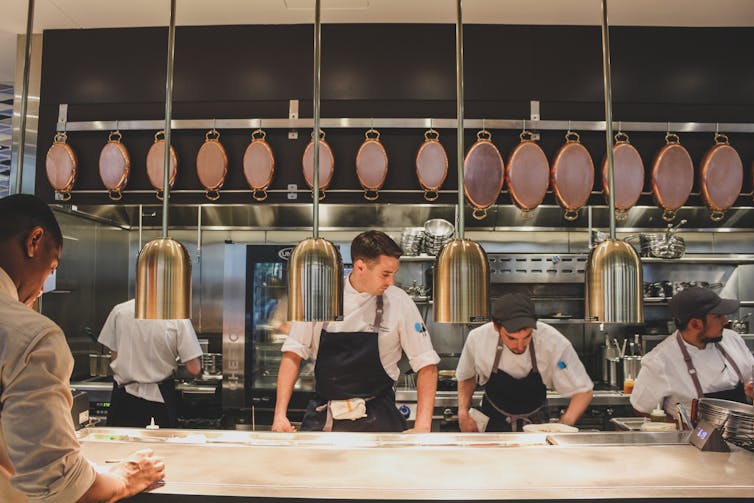
A line of chefs wearing black aprons at work in an open kitchen.
Local food writers believe Vernick Fish is a top contender for a Michelin star.
Photo courtesy of Vernick Fish

The obvious contenders

Philadelphia’s preeminent restaurant critic Craig LaBan and journalist and former restaurateur Kiki Aranita discussed local contenders for Michelin stars in a recent article in the Philadelphia Inquirer.

The 19 restaurants LaBan and Aranita discuss as possible star contenders average just over a one-mile walk from the Pennsylvania Convention Center.

Together they have received 78 James Beard nominations or awards, which are considered the “Oscars” of the food industry. That’s an average of over four per restaurant.

And when I tried to book a table for two on a Wednesday and Saturday before 9 p.m., about half were already fully booked for dinner two weeks out, in July, which is the slow season for dining in Philadelphia.

If LaBan’s and Aranita’s predictions are right, Michelin will be an added recognition for restaurants that are already successful and centrally located.

Exterior shot of a restaurant with outdoor seating in ground floor of rowhome
Black Dragon Takeout fuses Black American cuisine with the aesthetics of classic Chinese American takeout.
Jeff Fusco/The Conversation, CC BY-SA

Off the beaten path

When the Michelin Guide started in France at the turn of the 19th century, it encouraged diners to take the road less traveled to their next gastronomic experience.

It has since evolved into recommendations for a road well traveled: safe, lauded and already hard-to-get-into restaurants. In Philly these could be restaurants such as Vetri Cucina, Zahav, Vernick Fish, Provenance, Royal Sushi and Izakaya, Ogawa and Friday Saturday Sunday, to name a few on LaBan and Aranita’s list.

And yet Philadelphia has over 6,000 restaurants spread across 135 square miles of the city. Philadelphia is known as a city of neighborhoods, and these neighborhoods are rich with food diversity and innovation.

Consider Jacob Trinh’s Vietnamese-tinged seafood tasting menu at Little Fish in Queen Village; Kurt Evans’ gumbo lo mein at Black Dragon Takeout in West Philly; the beef cheek confit with avocado mousse at Temir Satybaldiev’s Ginger in the Northeast; and the West African XO sauce at Honeysuckle, owned by Omar Tate and Cybille St.Aude-Tate, on North Broad Street.

I hope the Michelin inspectors will venture far beyond the obvious candidates to experience more of what Philadelphia has to offer.

Small stacks of red hardback books that say 'Michelin France 2025'
The Michelin Guide announced it will include Philadelphia and Boston in its next Northeast Cities edition.
Matthieu Delaty/Hans Lucas/AFP via Getty Images

Raising the bar

In the frenzy surrounding the Michelin scrutiny, chef friends have invited me to dine at their restaurants and share my feedback as they refine their menus in anticipation of visits from anonymous Michelin inspectors.

Restaurateurs have been asking my colleagues and me for talent suggestions to replace well-liked and capable cooks, servers and managers whom owners perceive to be just not Michelin-star level.

And managers are texting us names of suspected reviewers, triggered by some tell-tale signs – a solo diner with a weeknight tasting menu reservation, no dietary restrictions or special requests, and a conspicuously light internet presence.

In all, I am excited about Philadelphians being excited about Michelin. Any opportunity to spotlight the city’s restaurant community and tighten its food and service quality raises the bar among local chefs and restaurateurs and makes the experience better for diners. And the prospect of business travelers and culinary tourists enjoying lunches and early-week dinners can help restaurants, their workers and the city earn more revenue.

But in the din of the press events and hype, let’s not forget that Philadelphians don’t need an outside arbiter to tell us what we already know: Philly is a great place to eat and drink.

Read more of our stories about Philadelphia.

The Conversation

Jonathan Deutsch does not work for, consult, own shares in or receive funding from any company or organization that would benefit from this article, and has disclosed no relevant affiliations beyond their academic appointment.
file-20250616-56-qvf5g4.jpg

How the end of carbon capture could spark a new industrial revolution

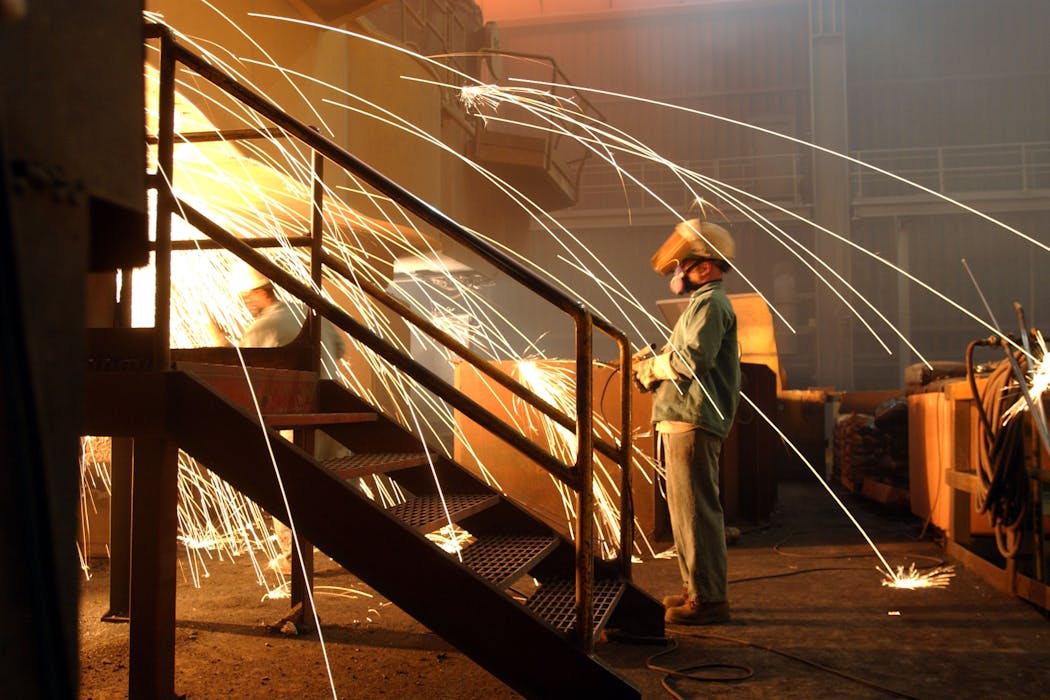
Steelmaking uses a lot of energy, making it one of the highest greenhouse gas-emitting industries.
David McNew/Getty Images

The U.S. Department of Energy’s decision to claw back US$3.7 billion in grants from industrial demonstration projects may create an unexpected opening for American manufacturing.

Many of the grant recipients were deploying carbon capture and storage – technologies that are designed to prevent industrial carbon pollution from entering the atmosphere by capturing it and injecting it deep underground. The approach has long been considered critical for reducing the contributions chemicals, cement production and other heavy industries make to climate change.

However, the U.S. policy reversal could paradoxically accelerate emissions cuts from the industrial sector.

An emissions reality check

Heavy industry is widely viewed as the toughest part of the economy to clean up.

The U.S. power sector has made progress, cutting emissions 35% since 2005 as coal-fired power plants were replaced with cheaper natural gas, solar and wind energy. More than 93% of new grid capacity installed in the U.S. in 2025 was forecast to be solar, wind and batteries. In transportation, electric vehicles are the fastest-growing segment of the U.S. automotive market and will lead to meaningful reductions in pollution.

But U.S. industrial emissions have been mostly unchanged, in part because of the massive amount of coal, gas and oil required to make steel, concrete, aluminum, glass and chemicals. Together these materials account for about 22% of U.S. greenhouse gas emissions.

The global industrial landscape is changing, though, and U.S. industries cannot, in isolation, expect that yesterday’s means of production will be able to compete in a global marketplace.

Even without domestic mandates to reduce their emissions, U.S. industries face powerful economic pressures. The EU’s new Carbon Border Adjustment Mechanism imposes a tax on the emissions associated with imported steel, chemicals, cement and aluminum entering European markets. Similar policies are being considered by Canada, Japan, Singapore, South Korea and the United Kingdom, and were even floated in the United States.

The false promise of carbon capture

The appeal of carbon capture and storage, in theory, was that it could be bolted on to an existing factory with minimal changes to the core process and the carbon pollution would go away.

Government incentives for carbon capture allow producers to keep using polluting technologies and prop up gas-powered chemical production or coal-powered concrete production.

The Trump administration’s pullback of carbon capture and storage grants now removes some of these artificial supports.

Without the expectation that carbon capture will help them meet regulations, this may create space to focus on materials breakthroughs that could revolutionize manufacturing while solving industries’ emissions problems.

The materials innovation opportunity

So, what might emissions-lowering innovation look like for industries such as cement, steel and chemicals? As a civil and environmental engineer who has worked on federal industrial policy, I study the ways these industries intersect with U.S. economic competitiveness and our built environment.

There are many examples of U.S. innovation to be excited about. Consider just a few industries:

Cement: Cement is one of the most widely used materials on Earth, but the technology has changed little over the past 150 years. Today, its production generates roughly 8% of total global carbon pollution. If cement production were a country, it would rank third globally after China and the United States.

Researchers are looking at ways to make concrete that can shed heat or be lighter in weight to significantly reduce the cost of building and cooling a home. Sublime Systems developed a way to produce cement with electricity instead of coal or gas. The company lost its IDP grant in May 2025, but it has a new agreement with Microsoft.

Making concrete do more could accelerate the transition. Researchers at Stanford and separately at MIT are developing concrete that can act as a capacitor and store over 10 kilowatt-hours of energy per cubic meter. Such materials could potentially store electricity from your solar roof or allow for roadways that can charge cars in motion.

How concrete could be used as a capacitor. MIT.

Technologies like these could give U.S. companies a competitive advantage while lowering emissions. Heat-shedding concrete cuts air conditioning demand, lighter formulations require less material per structure, and energy-storing concrete could potentially replace carbon-intensive battery manufacturing.

Steel and iron: Steel and iron production generate about 7% of global emissions with centuries-old blast furnace processes that use intense heat to melt iron ore and burn off impurities. A hydrogen-based steelmaking alternative exists today that emits only water vapor, but it requires new supply chains, infrastructure and production techniques.

U.S. Steel has been developing techniques to create stronger microstructures within steel for constructing structures with 50% less material and more strength than conventional designs. When a skyscraper needs that much less steel to achieve the same structural integrity, that eliminates millions of tons of iron ore mining, coal-fired blast furnace operations and transportation emissions.

Chemicals: Chemical manufacturing has created simultaneous crises over the past 50 years: PFAS “forever chemicals” and microplastics have been showing up in human blood and across ecosystems, and the industry generates a large share of U.S. industrial emissions.

Companies are developing ways to produce chemicals using engineered enzymes instead of traditional petrochemical processes, achieving 90% lower emissions in a way that could reduce production costs. These bio-based chemicals can naturally biodegrade, and the chemical processes operate at room temperature instead of requiring high heat that uses a lot of energy.

Is there a silver bullet without carbon capture?

While carbon capture and storage might not be the silver bullet for reducing emissions that many people thought it would be, new technologies for managing industrial heat might turn out to be the closest thing to one.

Most industrial processes require temperatures between 300 and 1830 degrees Fahrenheit (150 and 1000 degrees Celsisus for everything from food processing to steel production. Currently, industries burn fossil fuels directly to generate this heat, creating emissions that electric alternatives cannot easily replace. Heat batteries may offer a breakthrough solution by storing renewable electricity as thermal energy, then releasing that heat on demand for industrial processes.

How thermal batteries work. CNBC.

Companies such as Rondo Energy are developing systems that store wind and solar power in bricklike materials heated to extreme temperatures. Essentially, they convert electricity into heat during times when electricity is abundant, usually at night. A manufacturing facility can later use that heat, which allows it to reduce energy costs and improve grid reliability by not drawing power at the busiest times. The Trump administration cut funding for projects working with Rondo’s technology, but the company’s products are being tested in other countries.

Industrial heat pumps provide another pathway by amplifying waste heat to reach the high temperatures manufacturing requires, without using as much fossil fuel.

The path forward

The Department of Energy’s decision forces industrial America into a defining moment. One path leads backward toward pollution-intensive business as usual propping up obsolete processes. The other path drives forward through innovation.

Carbon capture offered an expensive Band-Aid on old technology. Investing in materials innovation and new techniques for making them promises fundamental transformation for the future.

The Conversation

Andres Clarens receives funding from the National Science Foundation and the Alfred P Sloan Foundation.

Stone tools from a cave on South Africa’s coast speak of life at the end of the Ice Age

The Earth of the last Ice Age (about 26,000 to 19,000 years ago) was very different from today’s world.

In the northern hemisphere, ice sheets up to 8 kilometres tall covered much of Europe, Asia and North America, while much of the southern hemisphere became drier as water was drawn into the northern glaciers.

As more and more water was transformed into ice, global sea levels dropped as much as 125 metres from where they are now, exposing land that had been under the ocean.

In southernmost Africa, receding coastlines exposed an area of the continental shelf known as the Palaeo-Agulhas Plain. At its maximum extent, it covered an area of about 36,000km² along the south coast of what’s now South Africa.

This now – extinct ecosystem was a highly productive landscape with abundant grasslands, wetlands, permanent water drainage systems, and seasonal flood plains. The Palaeo-Agulhas Plain was likely most similar to the present day Serengeti in east Africa. It would likely have been able to support large herds of migratory animals and the people who hunted them.

We now know more about how these people lived thanks to data from a new archaeological site called Knysna Eastern Heads Cave 1.

The site sits 23 metres above sea level on the southern coast of South Africa overlooking the Indian Ocean. You can watch whales from the site today, but during the Ice Age the ocean was nowhere to be seen. Instead, the site looked out over the vast grasslands; the coast was 75 kilometres away.

Archaeological investigation of the cave began in 2014, led by Naomi Cleghorn of the University of Texas. This work shows that humans have been using the site for much of the last 48,000 years or more. Occupations bridge the Middle to Later Stone Age transition, which occurred sometime between about 40,000 and 25,000 years ago in southern Africa.

That transition is a time period where we see dramatic changes in the technologies people were using, including changes in raw materials selected for making tools and a shift towards smaller tools. These changes are poorly understood due to a lack of sites with occupations dating to this time. Knysna Eastern Heads Cave 1 is the first site on the southern coast that provides a continuous occupational record near the end of the Pleistocene (Ice Age) and documents how life changed for people living on the edge of the Palaeo-Agulhas Plain.

Before the Ice Age, people there collected marine resources like shellfish when the coastline was close to the site. As the climate began to cool and sea levels dropped, they shifted their focus to land-based resources and game animals.

I am one of the archaeologists who have been working here. In a new study, my colleagues and I analysed stone tools from the cave that date to about 19,000 to 18,000 years ago, and discussed how the techniques used to make them hint at the ways that prehistoric people travelled, interacted, and shared their craft.

Based on this analysis, we think the cave may have been used as a temporary camp rather than a primary residence. And the similarity of the tools with those from other sites suggests people were connected over a huge region and shared ideas with each other, much like people do today.

Robberg technology of southern Africa

In human history, tools were invented in a succession of styles (“technologies” or “industries”), which can indicate the time and place where they were made and what they were used for.

The Robberg is one of southern Africa’s most distinctive and widespread stone tool technologies. Robberg tools – which we found at the Knysna site – are thought to be replaceable components in composite tools, perhaps as barbs set into arrow shafts, used to hunt the migratory herds on the Palaeo-Agulhas Plain.

We see the first appearance of Robberg technology in southern Africa near the peak of the last Ice Age around 26,000 years ago, and people continued producing these tools until around 12,000 years ago, when climate conditions were warmer.


Read more:
What stone tools found in southern tip of Africa tell us about the human story


The particular methods and order of operations that people used to make their tools is something that is taught and learned. If we see specific methods of stone tool production at multiple sites, it indicates that people were sharing ideas with one another.

Robberg occupations at Knysna date to between 21,000 and 15,000 years ago, when sea levels were at their lowest and the coastline far away.

The Robberg tools we recovered were primarily made from rocks that were available close to the site. Most of the tools were made from quartz, which creates very sharp edges but can break unpredictably. Production focused on bladelets, or small elongated tools, which may have been replaceable components in hunting weapons.

Some of the tools were made from a raw material called silcrete. People in South Africa were heat treating this material to improve its quality for tool production as early as 164,000 years ago. The silcrete tools at Knysna were heat treated before being brought to the site. This is only the second documented instance of the use of heat treatment in Robberg technology.

Silcrete is not available near Knysna. Most of the accessible deposits in the area are in the Outeniqua mountains, at least 50 kilometres inland. We’re not sure yet whether people using the Knysna site were travelling to these raw material sources themselves or trading with other groups.

Archaeological sites containing Robberg tools are found in South Africa, Lesotho and Eswatini, indicating a widespread adoption by people across southern Africa. The tools from the Knysna site share many characteristics with those from other sites, which suggests people were sharing information through social networks that may have spanned the entire width of the continent.


Read more:
65,000-year-old ‘stone Swiss Army knives’ show early humans had long-distance social networks


Yet there are other aspects that are unique to the Knysna site. Fewer tools are found in the more recent layers than in deeper layers, suggesting that people were using the site less frequently than they had previously. This may suggest that during the Ice Age the cave was used as a temporary camp rather than as a primary residential site.

Left with questions

Stone tools can only tell us so much. Was Knysna Eastern Heads Cave 1 a temporary camp? If so, what were they coming to the cave for? We need to combine what we learned from the stone tools with other data from the site to answer these questions.


Read more:
Ancient human DNA from a South African rock shelter sheds light on 10,000 years of history


Something we can say with confidence is that we have a very long and rich history as a species, and our innovative and social natures go back a lot further in time than most people realise. Humans living during the last Ice Age had complex technologies to solve their problems, made art and music, connected with people in other communities, and in some places even had pet dogs.

Despite the dramatic differences in the world around us, these Ice Age people were not very different from people living today.

The Conversation

Sara Watson works for the FIeld Museum of Natural History and Indiana State University

file-20250526-56-gfncwo.jpg

Small businesses are an innovation powerhouse. For many, it’s still too hard to raise the funds they need

The federal government wants to boost Australia’s productivity levels – as a matter of national priority. It’s impossible to have that conversation without also talking about innovation.

We can be proud of (and perhaps a little surprised by) some of the Australian innovations that have changed the world – such as the refrigerator, the electric drill, and more recently, the CPAP machine and the technology underpinning Google Maps.

Australia is continuing to drive advancements in machine learning, cybersecurity and green technologies. Innovation isn’t confined to the headquarters of big tech companies and university laboratories.

Small and medium enterprises – those with fewer than 200 employees – are a powerhouse of economic growth in Australia. Collectively, they contribute 56% of Australia’s gross domestic product (GDP) and employ 67% of the workforce.

Our own Reserve Bank has recognised they also have a huge role to play in driving innovation. However, they still face many barriers to accessing funding and investment, which can hamper their ability to do so.


The Federal Government is focussed on improving productivity. In this five-part series, we’ve asked leading experts what that means for the economy, what’s holding us back and their best ideas for reform.


Finding the funds to grow

We all know the saying “it takes money to make money”. Those starting or scaling a business have to invest in the present to generate cash in the future. This could involve buying equipment, renting space, or even investing in needed skills and knowledge.

A small, brand new startup might initially rely on debt (such as personal loans or credit cards) and investments from family and friends (sometimes called “love money”).

Having exhausted these sources, it may still need more funds to grow. Bank loans for businesses are common, quick and easy. But these require regular interest payments, which could slow growth.

Selling stakes

Alternatively, a business may want to look for investors to take out ownership stakes.

This investment can take the form of “private equity”, where ownership stakes are sold through private arrangement to investors. These can range from individual “angel investors” through to huge venture capital and private equity firms managing billions in investments.

It can also take the form of “public equity”, where shares are offered and are then able to be bought and sold by anyone on a public stock exchange such as the Australian Securities Exchange (ASX).

Unfortunately, small and medium-sized companies face hurdles to accessing both kinds.

Person writing on a whiteboard
Companies need access to finance to turn ideas into reality.
Kvalifik/Unsplash

Private investors’ high bar to clear

Research examining the gap in small-scale private equity has found 46% of small and medium-sized firms in Australia would welcome an equity investment – despite saying they were able to acquire debt elsewhere.

They preferred private equity because they also wanted to learn from experienced investors who could help them grow their companies. However, very few small and medium-sized enterprises were able to meet private equity’s investment criteria.

When interviewed, many chief executives and chairs of small private equity firms said their lack of interest in small and medium-sized enterprises came down to cost and difficulty of verifying information about the health and prospects of a business.

To make it easier for investors to compare investments, all public companies are required to disclose their financial information using International Financial Reporting Standards.

In contrast, small private companies can use a simplified set of rules and do not have to share their statements of profit and loss with the general public.

Share markets are costly and complex

Is it possible to list on a stock exchange instead? An initial public offering (IPO) would enable the company to raise funds by selling shares to the public.

Unfortunately, the process of issuing shares on a stock exchange is time-consuming and costly. It requires a team of advisors (accountants, lawyers, and bankers) and filing fees are high.

There are also ongoing costs and obligations associated with being a publicly traded company, including detailed financial reporting.

Last week, the regulator, the Australian Securities and Investments Commission (ASIC), announced new measures to encourage more listings by streamlining the IPO process.

Despite this, many small companies do not meet the listing requirements for the ASX.

These include meeting a profits and assets test and having at least 300 investors (not including family) each with A$2,000.

There is one less well-known alternative – the smaller National Stock Exchange of Australia (NSX), which focuses on early-stage companies. Ideally, this should have been a great alternative for small companies, but it has had limited success. The NSX is now set to be acquired by a Canadian market operator.

Making companies more attractive

Our previous research has highlighted that small and medium-sized businesses should try to make themselves more attractive to private equity companies. This could include improving their financial reporting and using a reputable major auditor.

At their end, private equity companies should cast a wider net and invest a little more time in screening and selecting high-quality smaller companies. That could pay off – if it means they avoid missing out on “the next Google Maps”.

Two people seated in a car, one holding a map open, and the other with a map app on their phone
What we now know as Google Maps began as an Australian startup.
Susan Quin & The Bigger Picture, CC BY

What about the $4 trillion of superannuation?

There are other opportunities we could explore. Australia’s pool of superannuation funds, for example, have begun growing so large they are running out of places to invest.

That’s led to some radical proposals. Ben Thompson, chief executive of Employment Hero, last year proposed big superannuation funds be forced to invest 1% of their cash into start-ups.

Less extreme, regulators could reassess disclosure guidelines for financial providers which may lead funds to prefer more established investments with proven track records.

There is an ongoing debate about whether the Australian Prudential Regulation Authority (APRA), which regulates banks and superannuation, is too cautious. Some believe APRA’s focus on risk management hurts innovation and may result in super funds avoiding startups (which generally have a higher likelihood of failure).

In response, APRA has pointed out the global financial crisis reminded us to be cautious, to ensure financial stability and protect consumers.


The author would like to acknowledge her former doctoral student, the late Dr Bruce Dwyer, who made significant contributions to research discussed in this article. Bruce passed away in a tragic accident earlier this year.

The Conversation

Colette Southam does not work for, consult, own shares in or receive funding from any company or organisation that would benefit from this article, and has disclosed no relevant affiliations beyond their academic appointment.

file-20250305-56-uw659u.jpg

Defence firms must adopt a ‘flexible secrecy’ to innovate for European rearmament

In the face of US President Donald Trump’s wavering commitments and Russian President Vladimir Putin’s inscrutable ambitions, the talk in European capitals is all about rearmament.

To that end, the European Commission has put forward an €800 billion spending scheme designed to “quickly and significantly increase expenditures in defence capabilities”, in the words of Commission President Ursula von der Leyen.

But funding is only the first of many challenges involved when pursuing military innovation. Ramping up capabilities “quickly and significantly” will prove difficult for a sector that must keep pace with rapid technological change.

Of course, defence firms don’t have to do it alone: they can select from a wide variety of potential collaborators, ranging from small and medium-sized enterprises (SMEs) to agile start-ups. Innovative partnerships, however, require trust and a willingness to share vital information, qualities that appear incompatible with the need for military secrecy.

That is why rearming Europe requires a new approach to secrecy.

A paper I co-authored with Jonathan Langlois of HEC and Romaric Servajean-Hilst of KEDGE Business School examines the strategies used by one leading defence firm (which we, for our own secrecy-related reasons, renamed “Globaldef”) to balance open innovation with information security. The 43 professionals we interviewed – including R&D managers, start-up CEOs and innovation managers – were not consciously working from a common playbook. However, their nuanced and dynamic approaches could serve as a cohesive role model for Europe’s defence sector as it races to adapt to a changing world.

How flexible secrecy enables innovation

Our research took place between 2018 and 2020. At the time, defence firms looked toward open innovation to compensate for the withdrawal of key support. There was a marked decrease in government spending on military R&D across the OECD countries. However, even though the current situation involves more funding, the need for external innovation remains prevalent to speed up access to knowledge.

When collaborating to innovate, firms face what open innovation scholars have termed “the paradox of openness”, wherein the value to be gained by collaborating must be weighed against the possible costs of information sharing. In the defence sector – unlike, say, in consumer products – being too liberal with information could not only lead to business losses but to grave security risks for entire nations, and even prosecution for the executives involved.

Although secrecy was a constant concern, Globaldef’s managers often found themselves in what one of our interviewees called a “blurred zone” where some material could be interpreted as secret, but sharing it was not strictly off-limits. In cases like these, opting for the standard mode in the defence industry – erring on the side of caution and remaining tight-lipped – would make open innovation impossible.

A weekly e-mail in English featuring expertise from scholars and researchers. It provides an introduction to the diversity of research coming out of the continent and considers some of the key issues facing European countries. Get the newsletter!

Practices that make collaboration work

Studying transcripts of more than 40 interviews along with a rich pool of complementary data (emails, PowerPoint presentations, crowdsourcing activity, etc.), we discerned that players at Globaldef had developed fine-grained practices for maintaining and modulating secrecy, even while actively collaborating with civilian companies.

Our research identifies these practices as either cognitive or relational. Cognitive practices acted as strategic screens, masking the most sensitive aspects of Globaldef’s knowledge without throttling information flow to the point of preventing collaboration.

Depending on the type of project, cognitive practices might consist of one or more of the following:

  • Encryption: relabelling knowledge components to hide their nature and purpose.

  • Obfuscation: selectively blurring project specifics to preserve secrecy while recruiting partners.

  • Simplification: blurring project parameters to test the suitability of a partner without revealing true constraints.

  • Transposition: transferring the context of a problem from a military to a civilian one.

Relational practices involved reframing the partnership itself, by selectively controlling the width of the aperture through which external parties could view Globaldef’s aims and project characteristics. These practices might include redirecting the focus of a collaboration away from core technologies, or introducing confidentiality agreements to expand information-sharing within the partnership while prohibiting communication to third parties.

When to shift strategy in defence projects

Using both cognitive and relational practices enabled Globaldef to skirt the pitfalls of its paradox. For example, in the early stages of open innovation, when the firm was scouting and testing potential partners, managers could widen the aperture (relational) while imposing strict limits on knowledge-sharing (cognitive). They could thereby freely engage with the crowd without violating Globaldef’s internal rules regarding secrecy.

As partnerships ripened and trust grew, Globaldef could gradually lift cognitive protections, giving partners access to more detailed and specific data. This could be counterbalanced by a tightening on the relational side, eg requiring paperwork and protocols designed to plug potential leaks.

As we retraced the firm’s careful steps through six real-life open innovation partnerships, we saw that the key to this approach was in knowing when to transition from one mode to the other. Each project had its own rhythm.

For one crowdsourcing project, the shift from low to high cognitive depth, and high to low relational width, was quite sudden, occurring as soon as the partnership was formalised. This was due to the fact that Globaldef’s partner needed accurate details and project parameters in order to solve the problem in question. Therefore, near-total openness and concomitant confidentiality had to be established at the outset.

In another case, Globaldef retained the cognitive blinders throughout the early phase of a partnership with a start-up. To test the start-up’s technological capacities, the firm presented its partner with a cognitively reframed problem. Only after the partner passed its initial trial was collaboration initiated on a fully transparent footing, driven by the need for the start-up to obtain defence clearance prior to co-developing technology with Globaldef.

How firms can lead with adaptive secrecy

Since we completed and published our research, much has changed geopolitically. But the high-stakes paradox of openness is still a pressing issue inside Europe’s defence firms. Managers and executives are no doubt grappling with the evident necessity for open innovation on the one hand and secrecy on the other.

Our research suggests that, like Globaldef, other actors in Europe’s defence sector can deftly navigate this paradox. Doing so, however, will require employing a more subtle, flexible and dynamic definition of secrecy rather than the absolutist, static one that normally prevails in the industry. The defence sector’s conception of secrecy must also progress from a primarily legal to a largely strategic framework.

The Conversation

Les auteurs ne travaillent pas, ne conseillent pas, ne possèdent pas de parts, ne reçoivent pas de fonds d'une organisation qui pourrait tirer profit de cet article, et n'ont déclaré aucune autre affiliation que leur organisme de recherche.